
Are megabanks too big to manage?
By Jennifer Liberto @CNNMoney May 11, 2012: 2:44 PM E
 JPMorgan Chase’s blunder raises questions about whether the big banks are just too big.
WASHINGTON (CNNMoney) — JPMorgan Chase’s $2 billion hedging blunder is adding fuel to those who think the megabanks are just too big.
JPMorgan Chase (JPM, Fortune 500) is in no danger of failing, thanks to much larger capital cushions mandated by the Dodd-Frank Act. But its mistake could have outsized repercussions in the global financial system, due to the sheer size of megabanks and the inter-connectedness of the global financial system.On Friday, stocks of all the big banks – including Morgan Stanley (MS, Fortune 500), Citigroup (C, Fortune 500) and Goldman Sachs (GS, Fortune 500) — were lower, as the JPMorgan Chase news undermined investor confidence in other Wall Street firms. U.K. regulators are reportedly looking into trades that transpired at the bank’s London office.
“It does make you wonder — this is one of the best managed banks in the country. What’s going on at these other institutions?” said Sheila Bair, former chief of the Federal Deposit Insurance Corp., in an interview with CNN’s Your Money to air Saturday. “Are they just too big to manage, even with very good managers?”
Economist Simon Johnson said the JPMorgan Chase episode highlights why U.S. regulators need to shrink big banks. He said the banks are so big and their trades are so complicated that even the Federal Reserve had no idea when it completed recent stress tests that JPMorgan could be facing these kinds of losses.
Shrinking the Wall Street banks is also a controversial goal of FDIC director Thomas Hoenig.
In a Senate Banking hearing on Wednesday, Hoenig said that while he’s not in favor of an “arbitrary size limit” on the big banks, he wants to go back to a system in which commercial banks’ banking activities are separated from Wall Street trades. He’d prohibit even market-making at banks, which is currently allowed by the Volcker Rule.
“Let’s take these high-risk activities and move them out in to the market,” Hoenig said.
Jaret Seiberg, a Washington policy analyst at Guggenheim Securities, said the JPMorgan blunder increases the possibility that some in Congress may try to separate commercial banking from trading operations. But he still thinks it’s unlikely Congress actually goes through with it.
On Friday, liberal lawmakers who have maintained the megabanks are too big issued statements saying the JP Morgan losses illustrate why the banks should be broken up entirely.
“The debacle at JPMorgan Chase reaffirms my view that the largest six banks in this country, including JPMorgan Chase, which have assets equivalent to two-thirds of our GDP, must be broken up,” said Sen. Bernie Sanders, a Vermont independent. 
————————————————————————————————————————-
———————————————————————————————————
U.S. Banks Tally Their Exposure to Europe’s Debt Maelstrom
BY PETER EAVIS John Kolesidis/ReutersDemonstrators in Athens. Banks are disclosing more of their exposure to Greece, Italy, Ireland, Portugal and Spain.
After a hurricane, homeowners check nervously to see if their insurance will cover all of the damage. With the European financial crisis still threatening a trail of defaults, United States banks are betting that their insurance is going to pay out.
Five large American banks, including JPMorgan Chase and Goldman Sachs, have more than $80 billion of exposure to Italy, Spain, Portugal, Ireland and Greece, the most economically stressed nations in the euro currency zone, according to a New York Times analysis of the banks’ financial disclosures.
- have made extensive use of a type of financial insurance, the credit-default swap, to help them offset any losses that might occur if defaults swamped the five troubled nations.
Using these swaps, along with other measures, the five banks have cut their theoretical exposure to the troubled countries by $30 billion, to $50 billion. The analysis also shows thatCitigroup has the greatest percentage of its exposure potentially protected, at 47 percent, while Bank of America has bought the least protection, at 12 percent.
 Justin Lane/European Pressphoto AgencyCitigroup, which runs Citibank, is confident it can collect on credit-default swaps.
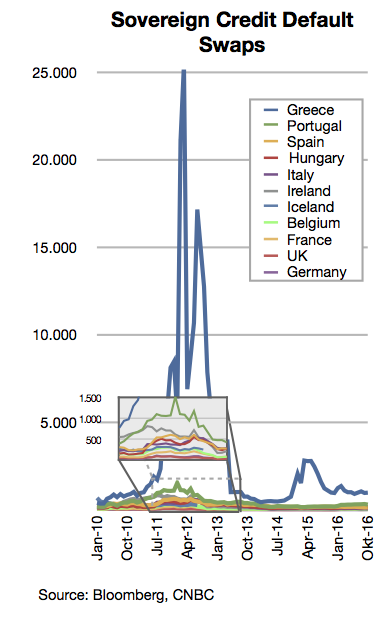
On Sunday, the Greek government appeared close to a deal with the majority of its creditors that would lead to big write-downs in the value of its debt. But even a deal could spawn a series of events that could lead to payouts on Greek credit-default swaps. While the Greek swaps would probably be paid, they represent only part of the $602 billion of swaps that have been written on the five troubled countries.
Credit-default swaps have functioned well for big bankruptcies, but they were also a big source of systemic weakness in 2008, when the American International Group nearly collapsed because it could not make payments on its side of its swaps contracts. Some market participants now doubt they would work properly during periods of great financial instability.
“The likelihood of actually getting paid out from owning a credit-default swap would be troubling to me if this were my hedge against a systemic shock — especially in a political environment unfriendly to more Wall Street bailouts,” Mark Spitznagel, chief investment officer at the hedge fund Universa Investments, said through a spokesman.
Since the A.I.G. debacle, regulators have been working to ensure financial firms will actually be able to make, or collect, payments on their swaps when markets are failing. While regulators have the power to get a detailed look at banks’ swaps positions, investors have struggled to get a solid grasp of their exposures from the banks’ financial filings.
Analyzing banks’ Europe-related swaps can be like a walk through a fun house, where appearances are distorted and you do not know what is around the corner. The degree of disclosure among the five banks differs greatly, and not all of them give a complete snapshot of their exposures and offsetting bets.
But that could change in February, when the banks release 2011 annual reports. The Securities and Exchange Commission this month requested that banks now provide fuller and more consistent presentations of their European positions, saying disclosures have lacked transparency, and might therefore be inadequate for investors. Bank representatives last week said they would comply with the guidance.
One upshot of the new disclosure might be that certain banks’ European numbers could suddenly look substantially bigger, since the S.E.C. is effectively asking banks to unbundle key exposures in their financial statements so outsiders can see how big they are before offsetting items.
“If you do see a jump in gross exposures, there will be new questions for management,” said Mike Mayo, a bank analyst with the brokerage CLSA.
Citigroup said it had $20.2 billion of exposure to the five stressed peripheral countries at the end of last year. The bank said it had $9.6 billion of “credit protection” on those countries, and had set aside $4.2 billion of collateral that would also offset its total exposure.
Collecting on the swaps would mean Citigroup’s counterparties having the money in stressed times to make a full payment. John Gerspach, Citigroup’s chief financial officer, said this month that the bank was highly confident it could collect, adding that the entities it bought protection from were “very high quality.”
Citigroup’s disclosed gross exposure to the five countries, including $7.4 billion in loans that have not actually been drawn, was $28.9 billion at the end of last year. Its net number, after credit-default swaps and collateral, was $15.1 billion. Put another way, Citigroup has “hedged” 47 percent of its disclosed exposure to the five countries.
Bank of America appears to have hedged the least, with only 12 percent of its stated $14.4 billion exposure offset with credit-default protection, according to the analysis. “We carefully manage our risk while still supporting our clients in Greece, Italy, Ireland, Portugal and Spain,” said a Bank of America spokesman, Jerome F. Dubrowski.
Like other firms, Bank of America has cut its European exposure by aggressively selling assets and cutting back on lending since 2009, when the region’s debt began to look like a serious problem. The bank’s exposure to the five countries is down by 44 percent since 2009, Mr. Dubrowski said. Also important, the new S.E.C. disclosure request could reveal the extent to which a bank has bought credit protection from banks based in the stressed European countries.
The fear is that a bank, say, in Italy, would be unable to pay out on its swaps if the country’s government went into default. Morgan Stanley implicitly recognizes that in its European disclosures. Alone among the five banks, it broke out the amount of default protection it had bought from banks in the five peripheral countries, about $1.43 billion.
Credit-default swaps can be dangerous because they have the ability to hit one side of the trade with a demand for an overwhelmingly large payout if a default occurs. Right now, it costs a bank $401,000 a year to insure $10 million of Italian government debt for five years, according to Markit, a data provider. If Italy took a serious turn for the worse, and its government debt seemed in real danger of default, that swap price would rapidly spike higher, as happened with Greece.
If that occurred, the bank that sold the protection might then have to post a lot of cash to ensure it would make good on the swap. Large cash calls like that might drain some banks of liquid assets, causing systemic stress.
If an important part of the financial system overhaul were in place by now, there may be fewer questions about whether banks would be able to meet cash calls in stressed times. The change involves directing most swaps trades to clearinghouses, whose job is to ensure that the money flows underlying a trade are made. Clearinghouses would standardize collateral payments across the default swap market, and they might demand higher amounts of collateral than banks currently demand from each other.
Recognizing this weakness in the derivatives market, finance ministers and central bankers from the Group of 20 leading industrialized nations said in 2009 that they wanted to have clearing in place for all standardized derivatives by the end of 2012.
Yet, as of June, only 9.4 percent of the $29.6 trillion credit-default swap market is centrally cleared, according to the Bank for International Settlements. Notably, the credit-default swaps that pay out if a European government defaults appear to have been held back from central clearing by the British regulator, the Financial Services Authority, which declined to comment on why it had not yet approved these swaps.
As things stand, banks may still be able to avoid using their default swaps, except, perhaps, those on Greece. That is because the European Central Bank has taken stronger actions to prevent the crisis from worsening, like making $620 billion of cheap loans to European banks in December. But the central bank’s moves do little to actually reduce European government debt levels.
Until those come down, the banks are betting on their hedges, imperfect as they may be.